
Simplify the resume creation process so that job seekers are able to create high-quality resumes effortlessly, improving their chances of securing job opportunities.
134x
CV upload growth within 8 months
+40%
Increase in repeat visits
+25%
Increase in overall session activity
The Problem
Job seekers faced significant challenges in crafting compelling resumes tailored to their desired roles. Many relied on outdated templates or manual adjustments, leading to a lack of alignment between their resumes and the specific job descriptions they were targeting. Despite their best efforts, they struggled to highlight key accomplishments and skills in a way that resonated with recruiters. NodeFlair's competitors in the career tech space offered basic resume creation tools but lacked features like real-time scoring, gamification, or AI-enhanced recommendations, leaving job seekers without a tangible reason to adopt these tools over traditional methods.
The Objective
NodeFlair Resume Builder was designed to enable job seekers to create high-quality resumes effortlessly, improving their chances of securing job opportunities. This initiative was driven by the need to simplify the resume creation process and increase user engagement. Through features such as resume scoring, AI-generated recommendations, and seamless integration with job applications, the Resume Builder aimed to increase CV uploads and foster sustained user interaction on the platform.
Research & Insights
The JTBD analysis for the Resume Builder project identified core user needs and frustrations throughout the resume creation journey. Key outcomes include minimizing time spent on determining resume purpose, formatting effectively, and writing impactful descriptions. Features prioritized included ATS compliance tools, resume analyzers, and a one-for-all template validated by hiring managers. This process involved user interviews and surveys to quantify the importance and satisfaction levels of each job step, ensuring development focus on high-opportunity areas.
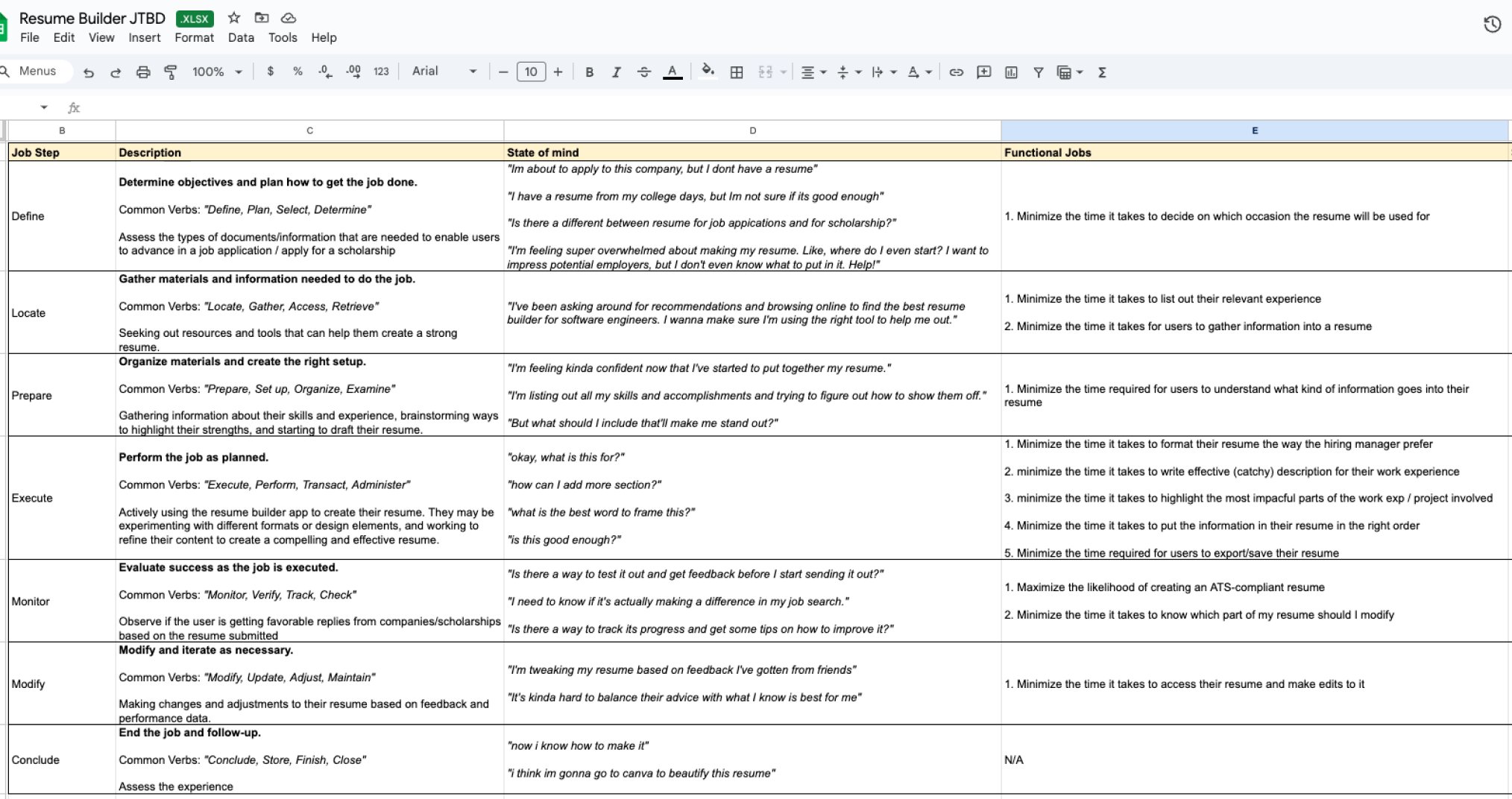
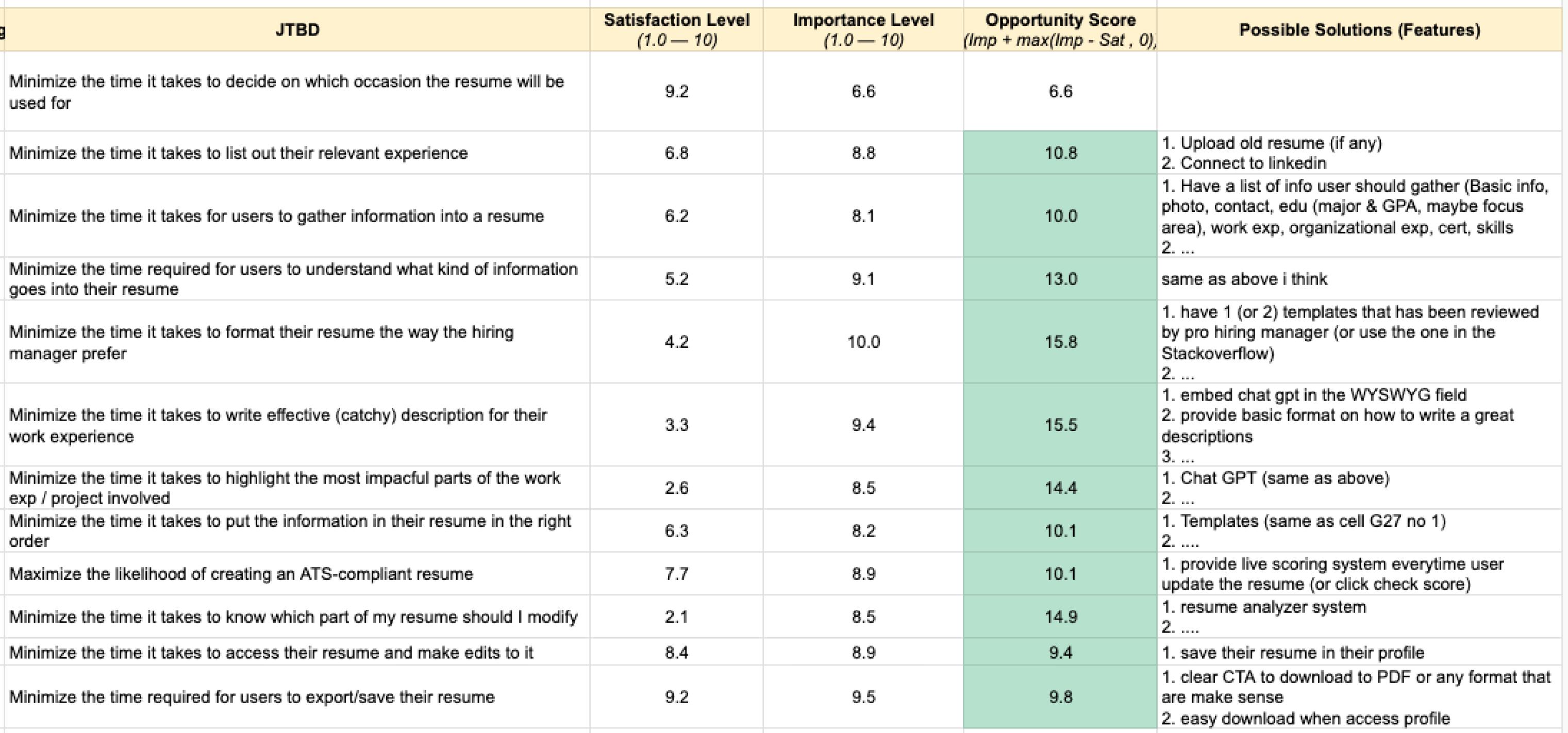
Below is a summary of the findings from the JTBD analysis:
The benchmarking aimed to identify unique features and best practices from leading resume builders and platforms like VMock. The goal was to align the platform's development with user needs uncovered in the JTBD analysis, such as reducing time for resume formatting, ensuring ATS compliance, and simplifying the process of writing effective job descriptions.
I analyzed multiple resume-building platforms, including EnhanceCV, JobScan, and ResumeMaker.ai, to evaluate their tools, features, and user engagement strategies. Additionally, I studied VMock's platform, focusing on elements directly addressing unmet user needs identified in the JTBD analysis, such as real-time scoring, resume impact definitions, and effective content suggestions.
To identify gaps and opportunities, I categorized the tools based on their feature offerings and assessed their relevance for NodeFlair users.
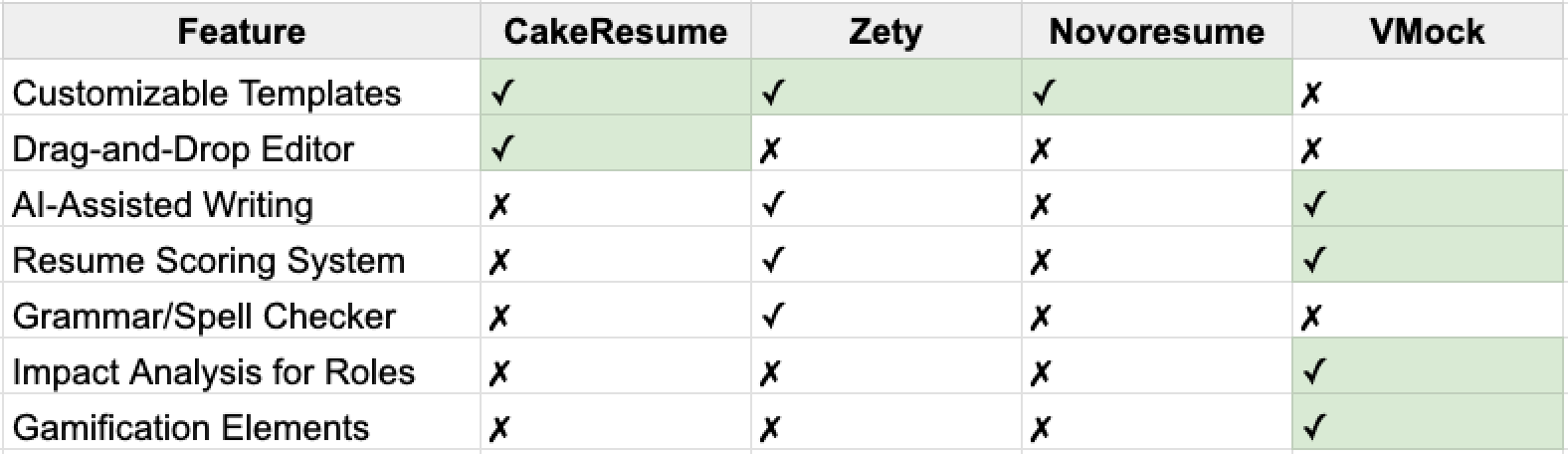
Based on the benchmarking analysis, the following insights were used to guide the development of the NodeFlair Resume Builder:
Strategy
To drive user engagement and increase CV uploads, we designed a Resume Builder that was intuitive and action-oriented.
Research revealed that users struggled with creating impactful resumes tailored to specific job openings. Based on these insights, our strategy was to simplify resume creation through an AI-powered, gamified experience while ensuring personalization and relevance. This approach not only made resume building seamless but also encouraged repeat use, fostering stronger user engagement across the platform.
Ideations
The user flow for the Resume Builder project outlines the seamless journey users take from discovering the feature to downloading a polished resume. Users can access the tool through various entry points, including searching Resume Builder on Google, navigating through NodeFlair's homepage or job detail pages, or leveraging saved resumes. First-time users are introduced to the platform through onboarding screens and tooltips, while returning users can quickly continue or start a new resume. The flow allows flexibility for users to upload existing resumes for analysis, auto-populate content via LinkedIn, or start from scratch using an intuitive editor. The journey concludes with AI-powered suggestions, resume scoring, and recommendations to ensure users create impactful resumes.
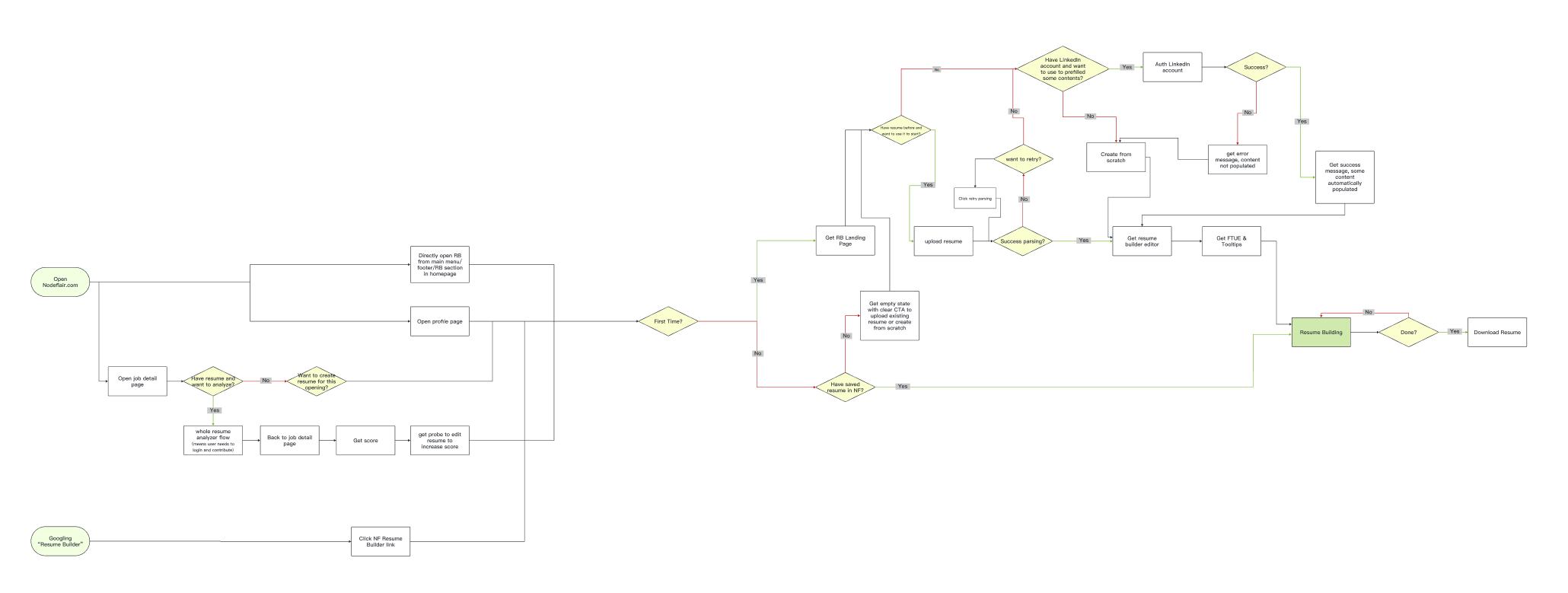
Designing this flow was not without its challenges. Achieving simplicity took significant effort, requiring me to benchmark multiple resume-building platforms to understand the industry standard and ensure our flow met user expectations. Furthermore, in the bigger picture, the Resume Builder is just one of several tools offered by NodeFlair to help users achieve their ultimate goal — landing a job. With this in mind, I had to ensure the flow was scalable, allowing the integration of other tools like the Resume Checker or Practice Interview without creating bottlenecks. Balancing simplicity, scalability, and user outcomes was crucial in crafting a streamlined and efficient experience.
The scoring mechanism for the Resume Builder was designed to help users systematically improve their resumes by highlighting gaps and offering actionable recommendations. By categorizing different sections into Important, Recommended, and Nice to Have, the system guides users to prioritize critical content that significantly impacts their resumes quality and effectiveness. This ensures that users focus on completing high-priority fields first while having the flexibility to refine their resumes further based on secondary and optional details.
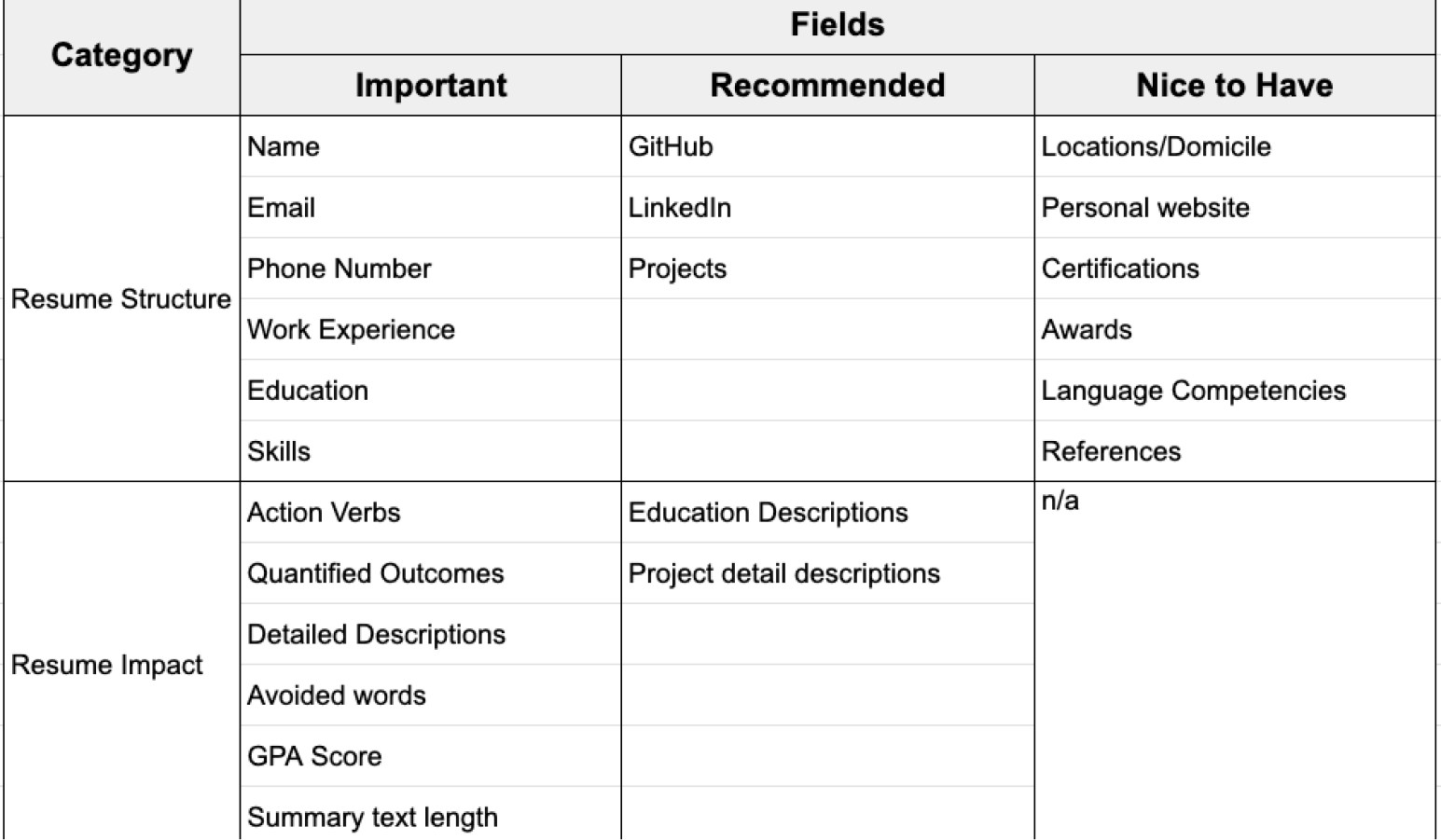
The scoring mechanism assigns a maximum of 100 points, divided across Important (60 points), Recommended (30 points), and Nice to Have (10 points) fields. Since users may have varying numbers of Work Experiences, Projects, and Education entries, the scoring system dynamically adjusts to account for this variability — each additional entry contributes incremental points, provided it includes detailed descriptions, quantified outcomes, or relevant details. A scoring cap is applied to maintain balance across all resume sections, ensuring no single area disproportionately impacts the overall score. This approach rewards users for thoroughness while accommodating differences in professional and educational backgrounds.
From the start of this project, the plan was to launch the tool as quickly as possible, gather extensive user insights, and iteratively improve the tool based on those insights. With this in mind, I deliberately designed the wireframe to minimize engineering effort and enable efficient implementation of the Resume Builder tool. The design decisions prioritized clarity and simplicity in the flow, making it straightforward for the engineering team to translate the design into a functional product. This approach was intended to allow the team to adapt quickly to user needs and ensure the tool evolved in the right direction.
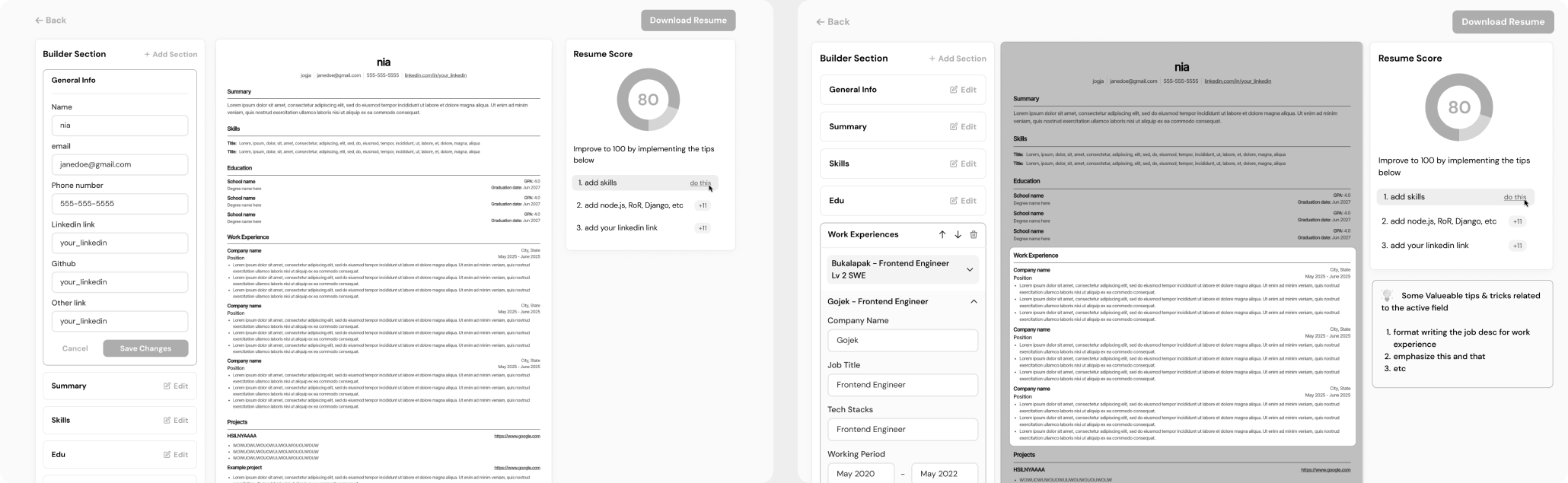
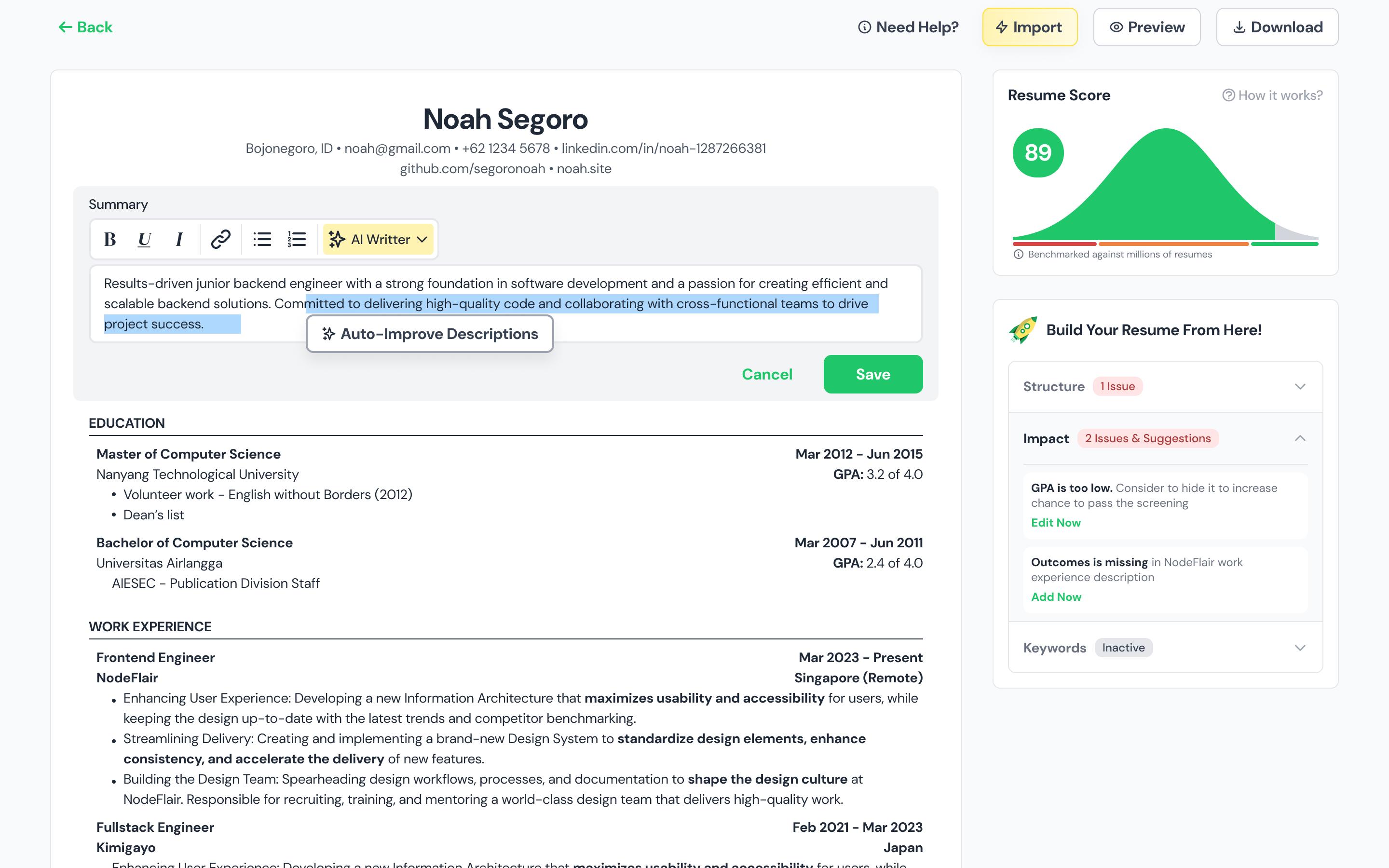
Key features included a Builder Section on the left for navigating and editing components like General Info, Skills, and Work Experience, with real-time updates and clear “Save Changes” CTA. The Resume Scorecard on the right provided instant feedback with actionable tips, such as "Add skills" or "Include LinkedIn link," guiding users to enhance their resumes. A dynamic preview panel in the center displayed live updates, ensuring transparency and a smooth editing process.
I consciously chose not to design the low-fidelity version for other screens because I found that this builder page is the most important among all screens related to the Resume Builder project. I decided to focus my time and effort on ensuring that the builder page was well-designed and polished enough for launch, even if it was just an MVP. My goal was not to simply rush the design and launch, but to put real thought into the design to deliver a functional and meaningful experience for users from the start.
The research activity for the Resume Builder project was conducted to validate the usability of the tool and identify friction points in the user journey, understand whether it met the needs of job seekers, assess the clarity and usefulness of the Resume Scorecard feature, and gather insights to prioritize post-launch iterations.
I recruited 8 participants with diverse backgrounds, ranging from fresh graduates to mid-level professionals actively seeking jobs, from NodeFlair's user base. Participants were given a pre-test briefing and asked to create a new resume, edit the Work Experience section to optimize their score, apply the Resume Scorecard's recommendations, and preview and finalize their resume. Data collection focused on both quantitative metrics (time on task, errors, score improvement) and qualitative feedback on usability and pain points.
Final Result
The initial release of the Resume Builder focused on delivering a simple yet impactful tool to help job seekers quickly create and enhance their resumes, incorporating core functionality designed to provide immediate value while minimizing development time:
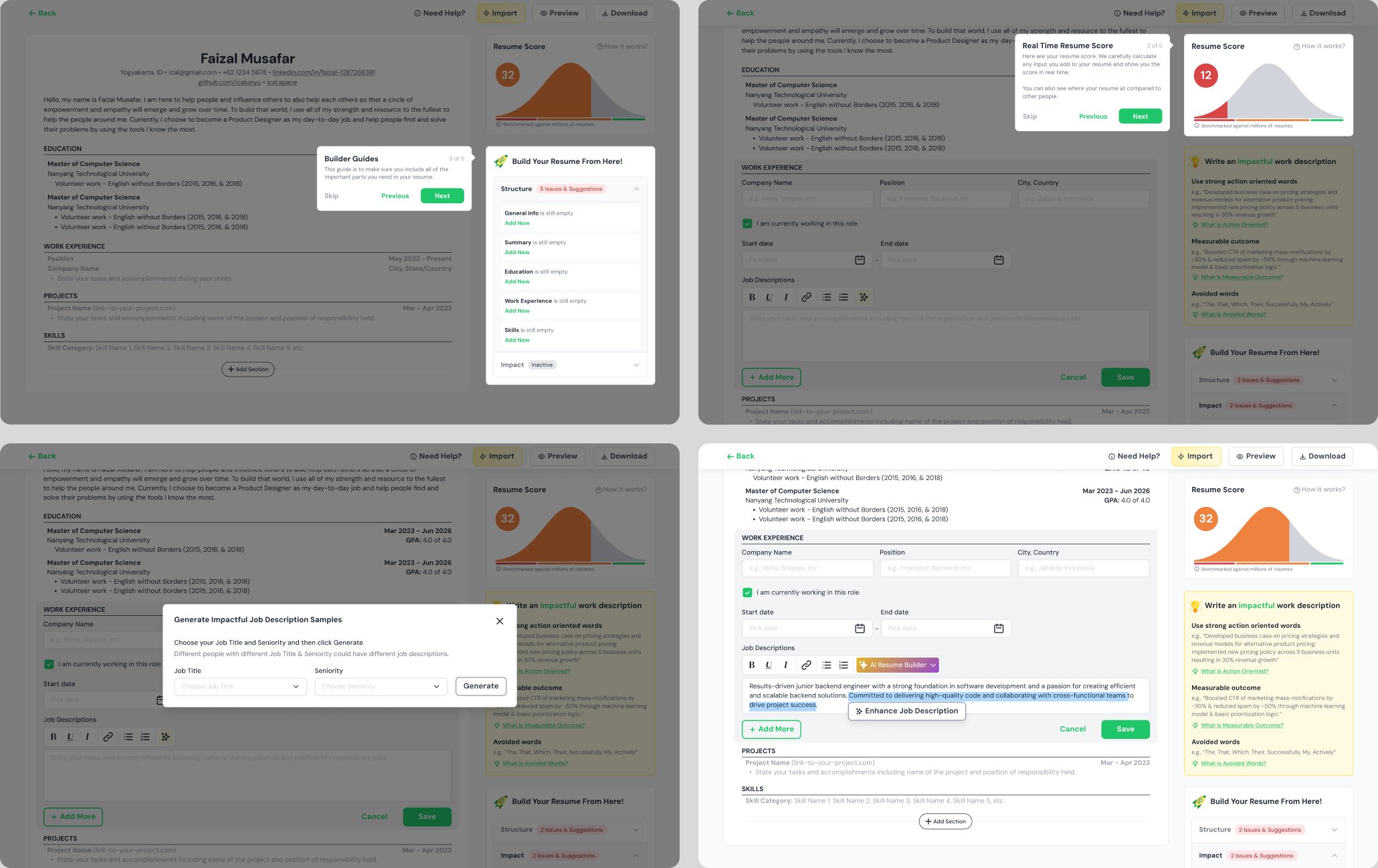
The results from this MVP release:
Released three months after the MVP, Resume Builder V2 brought significant improvements by addressing user feedback and refining the scoring mechanism to better align with job seekers' expectations and behavior:
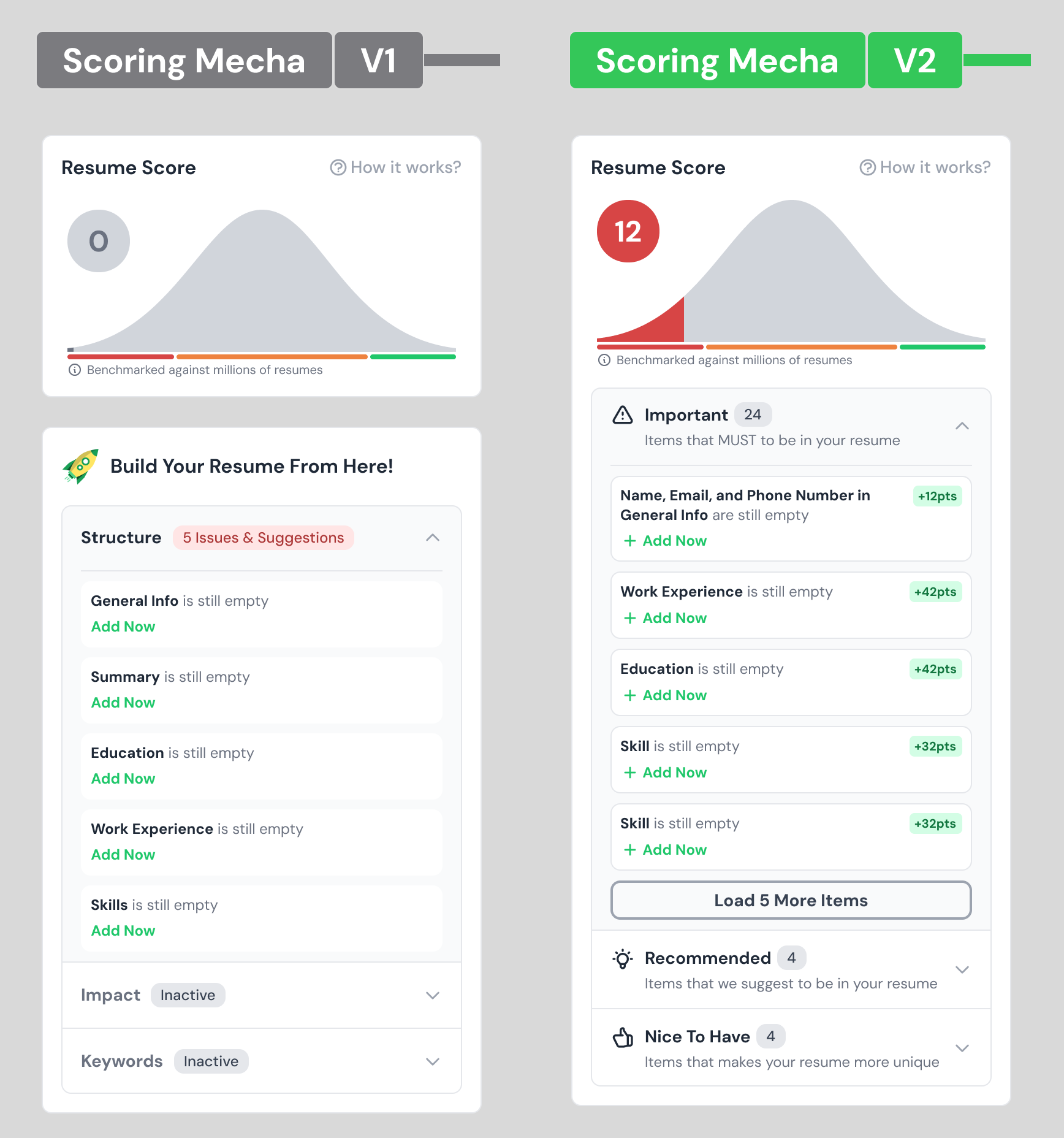
Refined Scoring Mechanism — user research revealed confusion around the terms "Impact" and "Structure," which were reworked into clearer labels: Important, Recommended, and Nice to Have, with tasks remapped so users could prioritize high-value improvements.
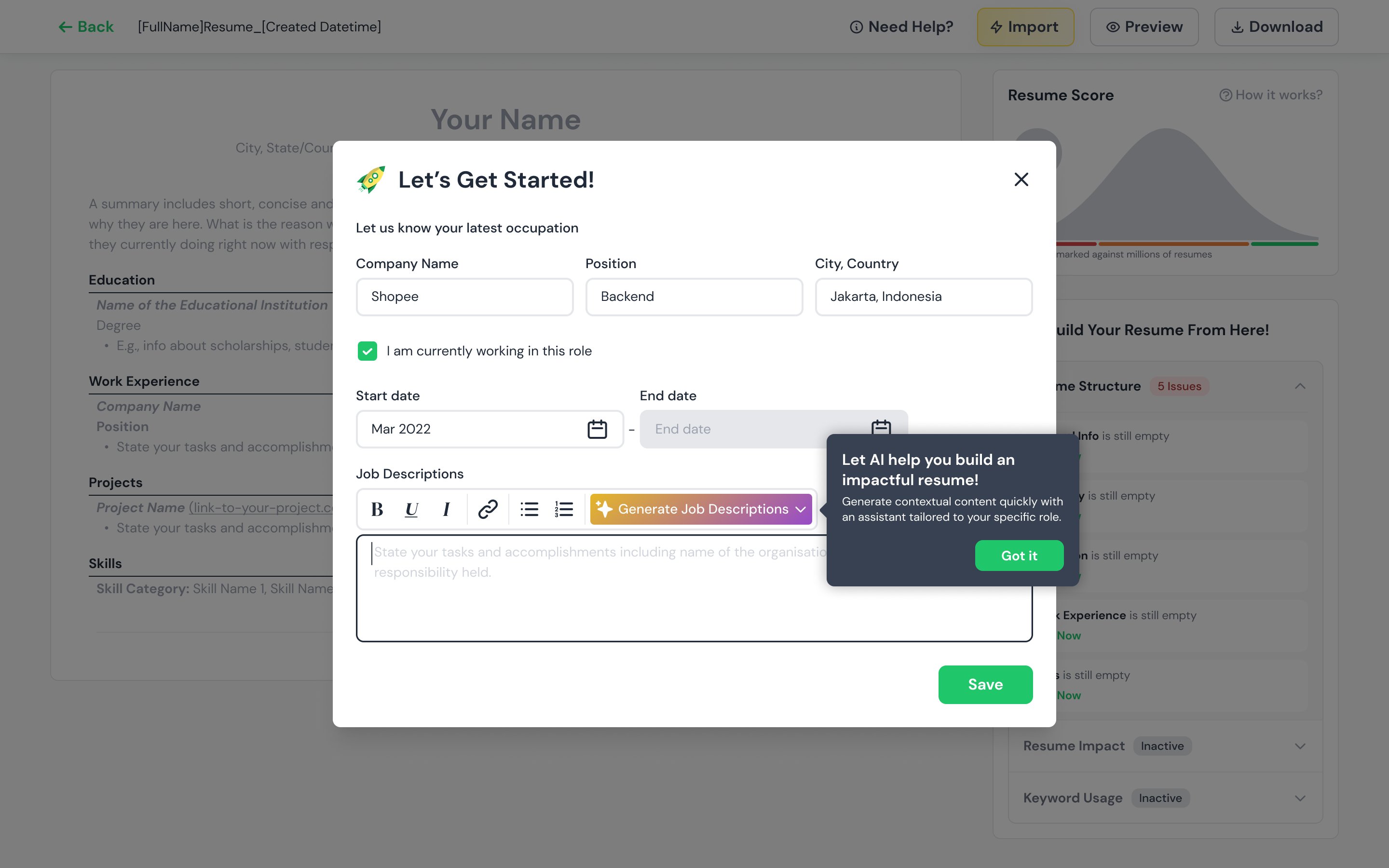
Start From Scratch — after 1 month of release, we saw a number of users who didn't start creating a resume from what they already had (uploading their current resume / inputting a LinkedIn link). Although this population isn't as large as those who start from their current resume/LinkedIn, we still added a first-time user experience feature for this type of user, to speed up resume creation and help them get familiar with our AI features.
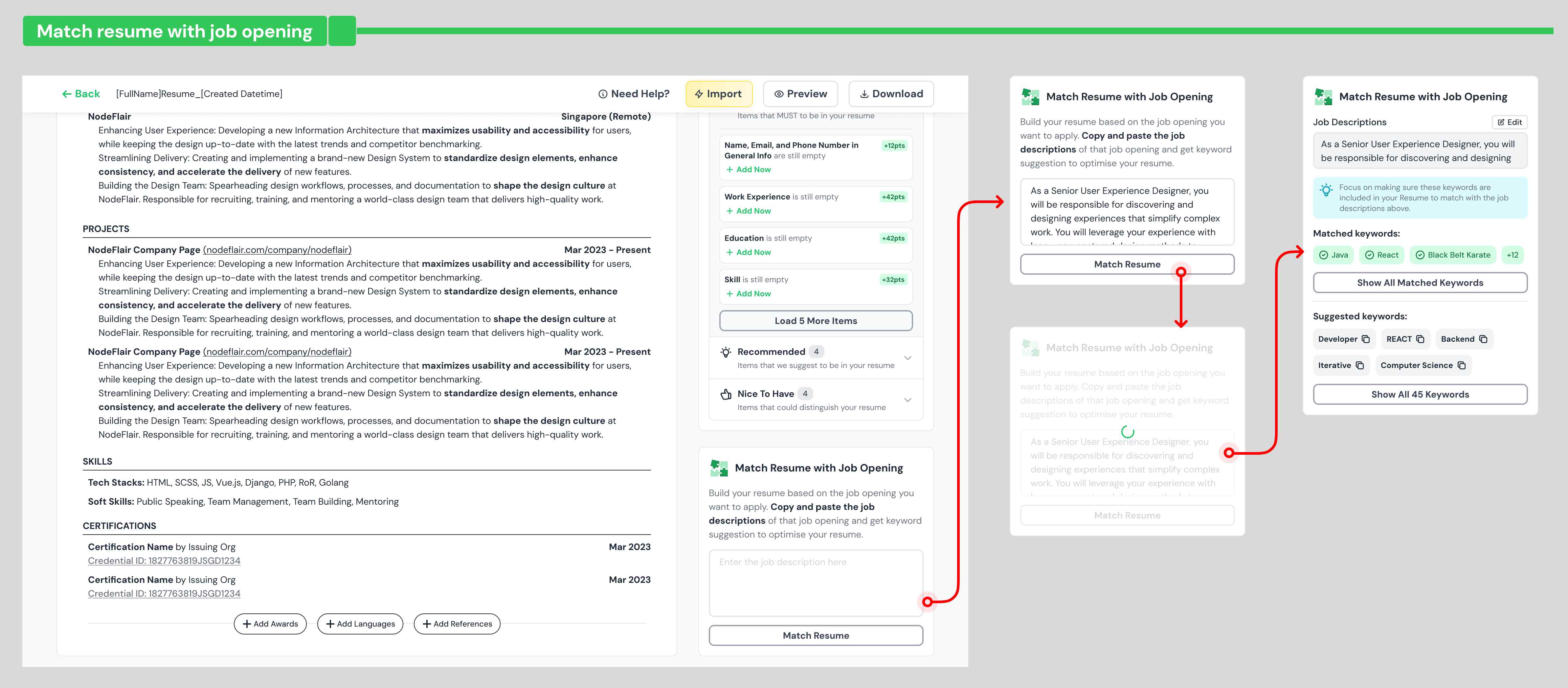
Match Resume with Job Opening — We found that many job seekers adjust their resume to match the job description of the role they're applying for. Based on that, we introduced a tool for users to generate important keywords straight from a job description, so they can weave them into the sections where they're most relevant.
The results from the V2 release:
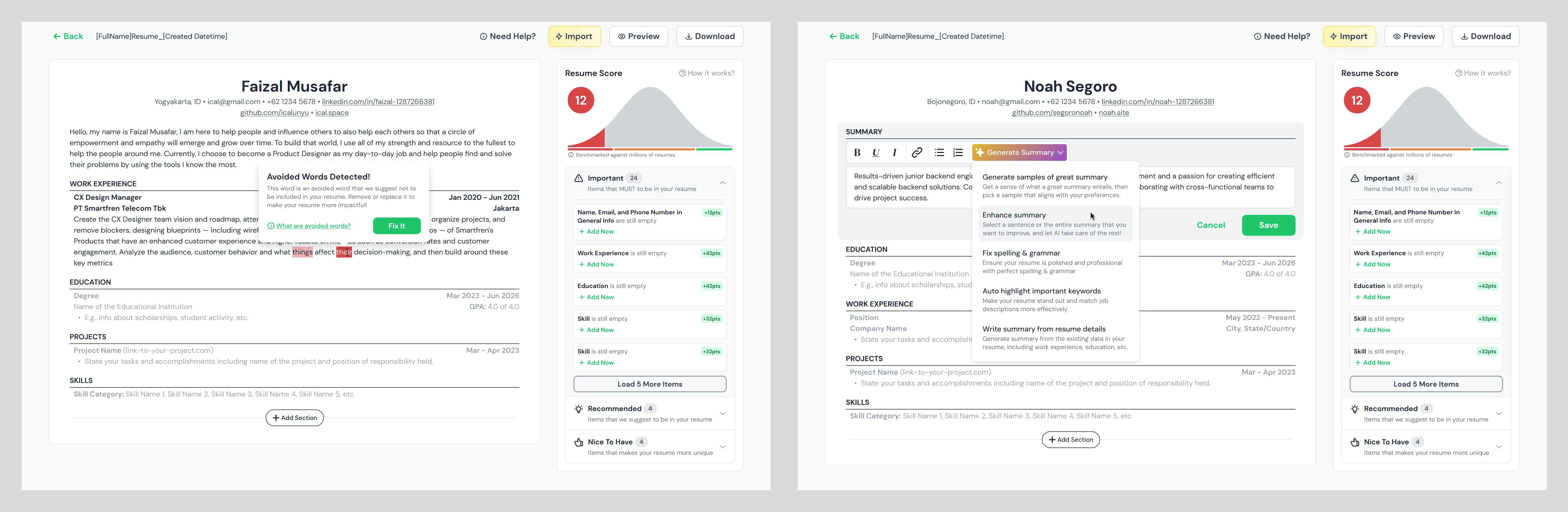
Building on the success of previous releases, we added more AI tools to help users pass the resume screening process for most job openings:
Impact
Resume Builder increased CV uploads by 134x within eight months — from 354 in October 2023 to 47,407 in June 2024.
Users who interacted with the Resume Builder spent significantly more time on the platform, with repeat visits increasing by over 40%.
Resume Builder acted as a gateway, boosting engagement with other features like the Resume Checker and Interview Generator, contributing to a 25% increase in overall session activity.
Personal Takeaways
Talking to the 8 participants during user testing — fresh graduates and mid-level professionals alike — made the JTBD findings feel real instead of just data points on a chart. Watching someone stare at a blank resume, unsure how to phrase an accomplishment or whether a bullet point was "impactful enough," was a different kind of insight than reading a survey score. It reshaped how I prioritized the Resume Scorecard's tone: less like a strict grader, more like a second pair of eyes nudging them in the right direction.
The MVP deliberately left out everything except the builder page itself — no low-fidelity exploration for the surrounding screens, no extra sections, no AI polish yet. That felt uncomfortable at the time, but it meant we validated the core loop (build, score, improve) with real usage within weeks instead of months. Every feature added in V2 and the latest release — additional sections, refined scoring labels, avoided-word detection — came directly from what that first version taught us, not from guessing upfront.
Redesigned CarWatch so it arms and disarms itself based on the driver's phone location and ignition …
+13%
Stolen vehicle recovery rate
A fast-turnaround website rebuild for a Bali-based architecture studio targeting expatriates and investors in the luxury …
52%
Visitor Growth
Designing a merchant referral program to expand Lummo's merchant base by turning existing merchants into growth …
+30%
Merchant base growth in first 3 months
Turning a young architecture studio's PDF-only portfolio into a website that helped it grow from 8 …
From 8 to 21
Projects Delivered Since Launch